
The Katharine Briggs Award 2025: Short List
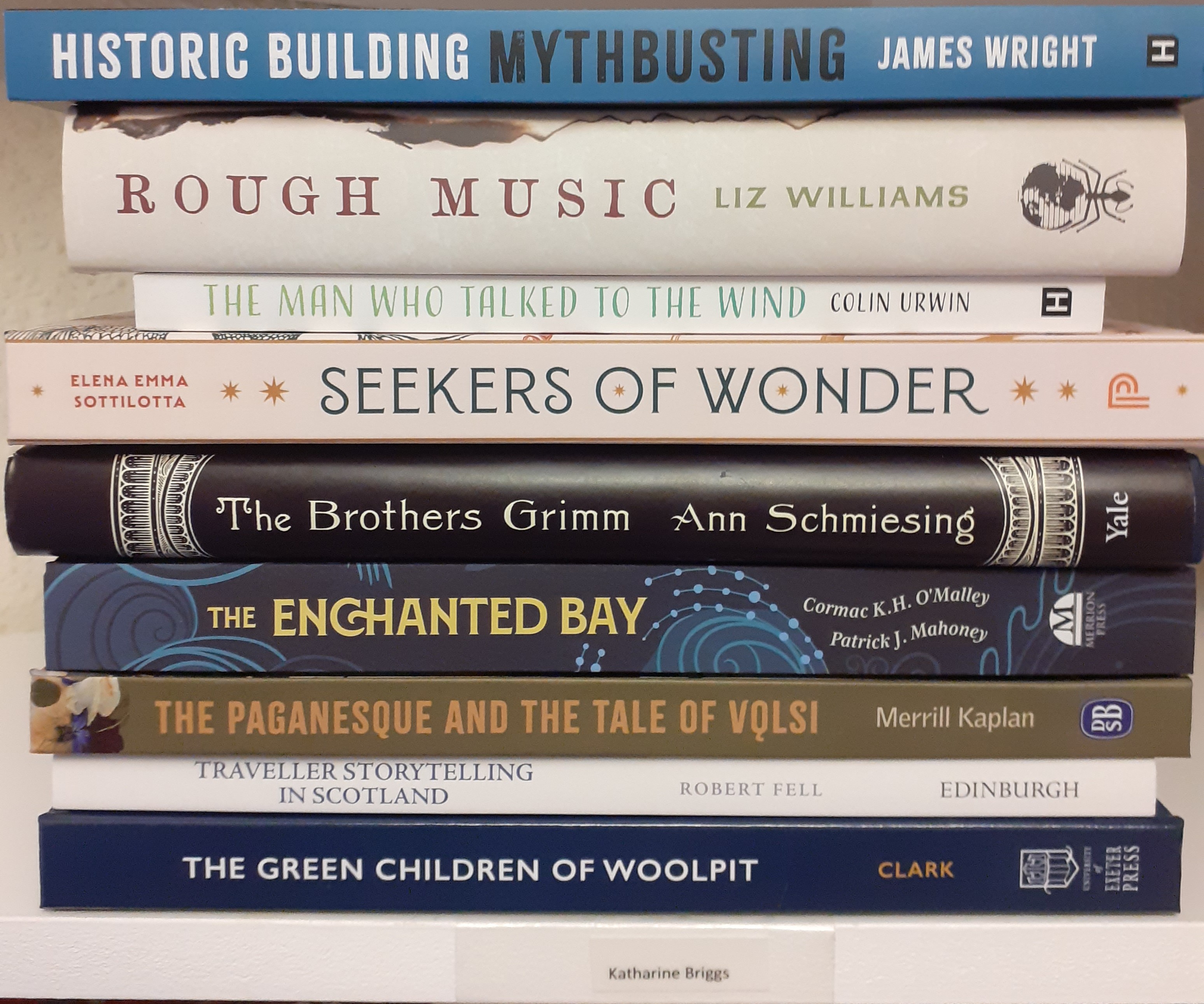
SHORT LIST and Judges' comments on the short-listed entries
(in alphabetical order by first author/editor surname)
John Clark, The Green Children of Woolpit: Chronicles, Fairies and Facts in Medieval England (University of Exeter Press)
Clark’s exhaustive scholarship examines not only the two medieval accounts of the ‘Green Children' but also the numerous later retellings and (mis)translations of their appearance in a 12th century Suffolk village. The result is a meticulous yet highly readable study, built upon the research of decades.
Robert Fell, Traveller Storytelling in Scotland: Folklore, Ideology, Cultural Identity (Edinburgh University Press)
Both intellectual and impassioned, this rigorous monograph examines the importance of storytelling for Traveller/Gypsy self-identification. Grounded in the latest theoretical work in Folklore Studies yet also imbued with respect and compassion, Fell’s book is a rich academic study that adds a great deal to our understanding of a much-marginalised people.
Merrill Kaplan, The Paganesque and The Tale of Vǫlsi (Boydell & Brewer)
Long credited as an example of pre-Christian fertility worship, Kaplan’s analysis of The Tale of Vǫlsi dismisses this interpretation and instead builds a forceful argument for it being a knowing ‘folkloresque’ construction for an attuned fourteenth century audience. A combination of erudite scholarship and patient analysis which makes a considerable contribution to both folkloristics and early literature studies alike.
Cormac K.H. O'Malley and Patrick J. Mahoney, The Enchanted Bay: Tales and Legends from Ernie O'Malley's Irish Folklore Collection (Merrion Press)
A wonderful collection, bringing together a selection of hitherto unpublished tales and anecdotes. Aimed at a wide audience it comes complete with a high standard of contextual information and archival detail. Its local focus and overall thematic organisation, greatly contribute to the value and enjoyment of the volume.
Ann Schmiesing, The Brothers Grimm: A Biography (Yale University Press)
This work brilliantly illuminates the surrounding social and cultural contexts which shaped the Grimms and their work. A work with tremendous contemporary resonance given that the questions the Grimms raised around the nature of ‘folklore’ itself are ones we are still grappling with in the 21st century. Excellently researched and written in a clear and readable style this is an impeccable study for specialist and non-specialist alike.
Elena Emma Sottilotta, Seekers of Wonder: Women Writing Folk and Fairy Tales in Nineteenth-Century Italy and Ireland (Princeton University Press)
A detailed study which highlights telling details and differences in the role of women as collectors and disseminators of folkloric material in Ireland and Italy. Seekers of Wonder is a rich and incisive monograph, rooted in detailed archival study but supported with detailed theoretical insights.
Colin Urwin, The Man who Talked to the Wind, and other Rathlin Folk Tales from the Tommy Cecil Archive (The History Press)
A fine example of popular folklore publishing, in which a collection of tales from a relatively unexplored primary archive in Northern Ireland is contextualised with informative references and telling personal details. Many a publisher could learn from its arrangement and style.
Liz Williams, Rough Music: Folk Customs, Transgressions, and Alternative Britain (Reaktion Books)
A brilliantly accessible book which combines a strong historical overview with insightful interviews with present day practitioners. Alert to the nature of how change is embedded in folk practice, the author is also to be commended for their considered and clear-sighted treatment of more controversial folk customs and practices and in how they are interpretated in the 21st century.
James Wright, Historic Building Mythbusting: Uncovering Folklore, History and Archaeology (The History Press)
Wright gently explodes a number of myths surrounding historic buildings, through a combination of cross-disciplinary research and his hands-on knowledge as an architectural archaeologist. An immensely readable, revealing and illuminating book, deserving of the widest possible audience.
The winner will be announced on Tuesday 11 November at Swedenborg Hall, 20/21 Bloomsbury Way, London WC1A 2TH, after the Katharine Briggs Lecture.
Our speaker this year is Professor Terry Gunnell, Professor Emeritus in Folkloristics at the University of Iceland, who will talk about ‘Returning the Legends to the Landscape and the Storytellers: The ever-increasing benefits of digitalising the North Atlantic Folk Legend Archive’. The lecture begins at 18:30.
Following the lecture, The Folklore Society President, Prof. David Hopkin, will read out the judges’ report on the Katharine Briggs Award short list and will announce the winner and present the prize. The winner of the 2025 Doc Rowe Award (formall the Non-Print Media Award) will also be announced.
Afterwards, drinks and snacks will be served, and all the books entered for the Katharine Briggs award will be on display for our guests to browse.
Tickets: £10.00 (£5 for Folklore Society members with the Discount Code: just log on to the Members area to find the Discount Code) from: https://www.eventbrite.co.uk/e/the-katharine-briggs-lecture-and-book-award-2025-tickets-1417210868859
< The Katharine Briggs Award 2025 - winner announced Offbeat Presents: An Evening with Doc Rowe - 10th November 2025 >Tagged under: Awards and Prizes