
Intern post: The Opie Boxes
Dear readers,
This afternoon, I wrote back to my (email) penpal who had surprised me by asking, after we’d been talking about zodiac signs: Do I believe in anything? Destiny or god, fairies or aliens?
I noticed something weird about my response - it was as if I was preparing to make my case in a court of law. “Point 1. The year: 2004. I was born and baptized Catholic…” Like some deep internal defenses were triggered, making me write in a very stripped-down, “objective” style. And probably boring my poor correspondent to death!
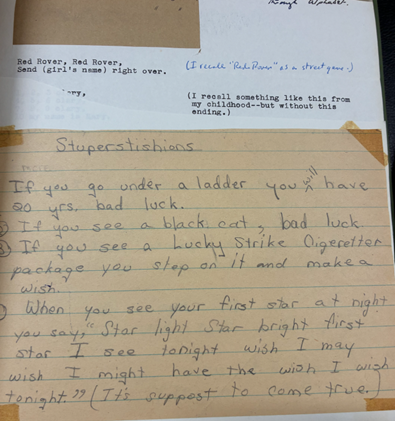
People want their beliefs to make sense to others and it’s not every day you meet someone so eager to listen and take supernatural belief seriously! Well, the renowned British folklorist couple, Peter and Iona Opie, were two just such people, who appreciated those reports of rituals and worldviews that are not rooted in science, but something more mysterious. During my internship with the Folklore Society, it has been a wonderful experience - full of unexpected insights - getting to work with the collection of Opie research material over at UCL, a considerable volume of notes, press cuttings, and survey responses eventually published by Oxford University Press as The Dictionary of Superstitions in 1989. (The Opie material at UCL is a sub-set of the Folklore Society's archives. The majority of the Opie's papers are housed at the Bodleian Library. For more on the Opies and their work see The Opie Archive website).
This material was completely absorbing, at times horrifying, and sometimes very funny. I loved my regular visits to the UCL Reading Room. Lots of interesting questions came up in the archives and in the process of making a finding aid for the first time:
-What does it mean to be an archivist? How can the position combine a stance of humility and care with the interrogation of categories and hierarchy?
-How is the allocation of space a manifestation of attention? What is the relationship between competition for space and the accessibility of cultural heritage?
-Is there something special about physical collections that can’t be replicated digitally?
Again, I am so grateful for having this opportunity and under the guidance of such kind and brilliant folks - thank you Ross MacFarlane for the introduction and mentorship on all things archival.
< Folklore on the Move: The Folklore Society's Annual Conference 2026 Intern post: Caida and the Cuttings >Tagged under: People