
Intern post: Caida and the Cuttings
Dear readers,
Your friendly Folklore Society intern, Caida, here! I’m writing today to share about one of the tasks I’ve been working on over the past few weeks: scanning the FLS Library Cuttings Collection.
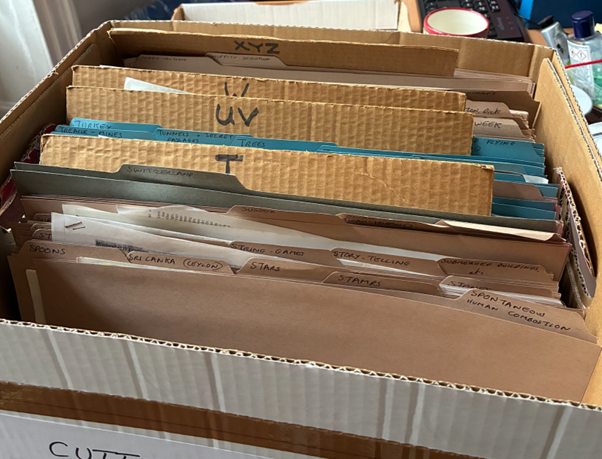
This is a composite collection, mostly made up of copies of press cuttings from Steve Roud, creator of the Roud Folk Song Index and formerly Honorary Librarian of the Folklore Society, plus donations from Gordon Ridgewell and others. Though not updated since the mid-1990s, there is plenty of material to process. An aerial view of the box contents is pictured above - as you can imagine, several boxes were needed to hold the rest of the alphabet, and some letters, like M and S (British pun ifykyk), were more popular than others.
When I’m doing in-person hours at the FLS office, and have already chatted with my office-mates and had a cup of tea (with one green tea bag and one chamomile-citrus), then it’s usually Cuttings Collection time. It’s nice to move the files right beside the copy machine because it makes the process marginally more efficient, though the office is (endearingly!) compact to begin with. Prior to scanning, the boxes live in the corner behind Ross’ desk; if he’s in-office, Ross ducks and very kindly waits for the space above his head to no longer be so heavily trafficked by giant cartons of folklore.
And then the scanning. It took some trial and error, but now I really get into a rhythm: insert thumbdrive, new folder, open copy scanner, paper face down! Dialed in to the whirring noise of the scan as it takes its trip to the bottom of the paper and back up, so I know the exact second when it’s safe to raise the lid and switch the next paper. Or if I’m alone, blasting Spotify in my headphones, a hand on top of the machine - vibration stops, scan over, next!
So, this is how the Cuttings Collection has become my gateway to meditation. Just kidding (sort of). I do think, in this recent revival of folklore in popular culture, the field gets the image of being all “Witches and Zombies”- and studying belief in the supernatural is important! But there’s more to it (I find it delightful that the topics covered in just the S category range from “spoons” to “spontaneous human combustion”). There’s another mystifying phenomenon that doesn’t get near enough love, which is, you guessed it: photocopying. Not to sound like I’ve never used a computer before, but isn't it kind of amazing how an archive can take up all the room under someone’s bed one day, and the next, occupy no more space in the physical world than a mini Snickers?
Of course, I don’t say that to discredit physical media and collections that you can touch, pages you can turn - those experiences do offer something special. The Cuttings Collection cuttings are funny because a lot of the images were themselves paper-printed photocopies - so for Dr. Roud or Mr. Ridgewell or someone else, it mattered to have an “analog” version (in the sense that paperback books are the “analog Kindle”). Nostalgia for print media butts up against economic/ space/accessibility limitations in interesting ways, and this project has given me a great chance to dig further into those relationships.
< Intern post: The Opie Boxes ''Oss 'Oss, Wee Oss'' Book >Tagged under: People